 Related to Elements: DJ, Crate Digging, 12" Single
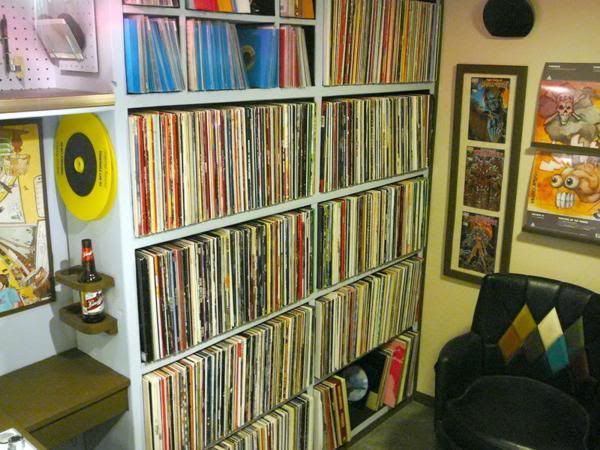
All DJs and Crate Diggers know how difficult it is to safely store their records. Record shelves can be a great way to keep the records right at your fingertips, but the ones they sell online can be extremely expensive to buy and ship. Well, put on your DIY hat, adjust your tool belt for your winter waistline, and build it yourself! You’ll save yourself all a whole lot of money that you can wisely spend on records instead. You probably have all the tools you need to do this rusting away somewhere right now.
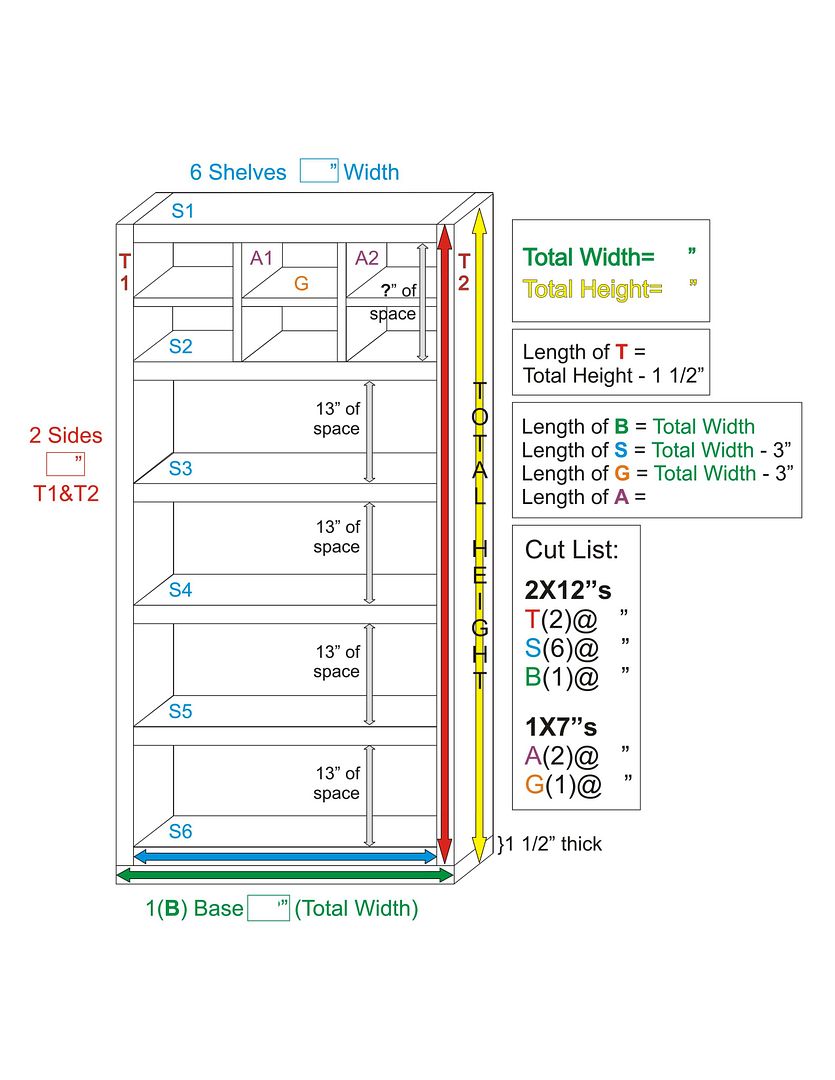
CLICK HERE FOR 8.5 X 11 INCH PRINTABLE PLANS WITH BLANK VALUES FOR YOUR MEASUREMENTS.
Tools and Supplies Needed:
The Basics:
- Pencil
- Tape measure
- Carpenters’ Square
- Saw (preferably chop saw or circular saw, but a hand saw will work too if you don’t mind sweating)
- Power Drill
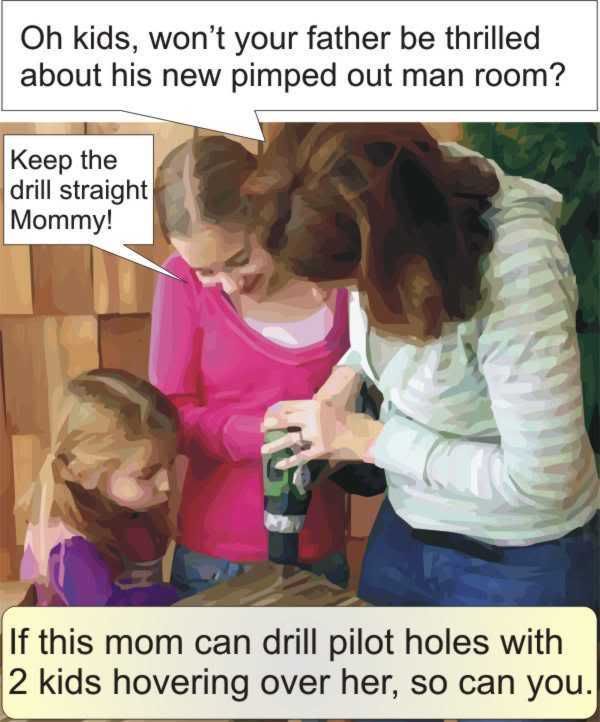
- Pilot Hole Drill Bit (recommended, else tiny drill bit will work)
- Heavy Duty Deck Screws 3.5” or longer (preferably self-tapping so they sink in better)
- 2X12” Wood Boards (how many depends on size you want)
Optional: (If incorporating 7 inch shelves)
- 1X7” Wood Boards (how many depends on size you want)
- Narrow gauge screws or small nails or glue
- 1” chisel
Optional: (If incorporating Stack Stoppers)
- 1” Quarter Round corner wood (size depends on how many you want)
- Velcro pieces
Recommended: (For that clean built in look)
- Corner Clamps or a friend (these really come in handy for holding the wood during construction)
- Wood Glue (if using center supports)
- Sander\Sandpaper
- Caulk (to fill in screw holes)
- Paint (your color of choice)
- Felt (cut to size of shelves)
- Sharp Scissors (to cut felt)
- Spray Glue (for adhering felt liner) (I recommend 3M Super 77)
- Rubber Gloves
- Paint Thinner (for cleanup of spray glue)
- Beer (gotta have beer for a project like this)
Do the Math
First things first! Determine the size the shelf will take up in your room. Start by measuring the footprint you want it to take up (the total width) and write it down on the printable plans. Next measure the EXACT height from floor to ceiling. Measure twice, cut once! That height will be the total height of the record shelves as it uses the floor and ceiling to prevent it from tipping over and killing you. (But damn! What a way to die, right?) Now, write down the total height on the printable plans. With those two measurements you already have all you need to determine how many pieces of wood need to be cut at what size.
For Fans of Forty Fives
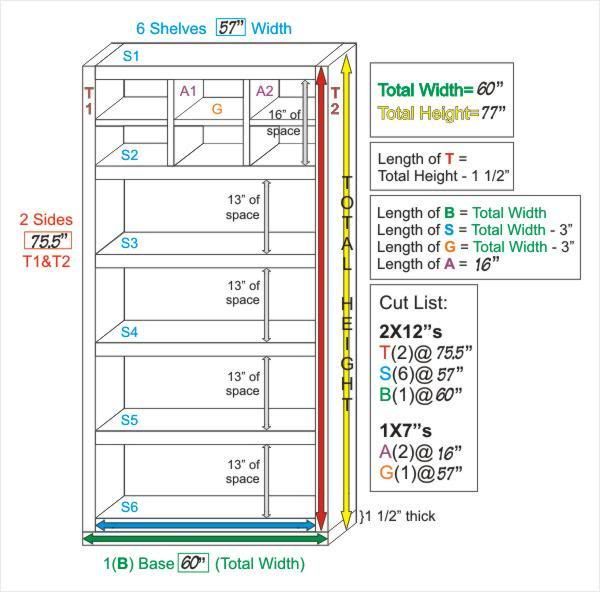
You can go with or without a 7 inch shelf compartment depending on your needs. However, make sure that you allow AT LEAST 16” or more height space in order to have enough room for both levels of 7” records. This depends on your ceiling height. For example, I have a low ceiling of 77” which leaves me the bare minimum amount of space needed to incorporate a 16” tall 45 shelf. If you have 79 inch tall ceiling you can have an 18” tall 45 shelf. The higher your ceiling is, the more room you will have for your 45s.
If you decide to incorporate this 7 inch shelf, do it in the top shelf space. Each standard shelf below it will always have 13 inches of space in between each shelf to accommodate slightly larger record covers or box sets.
Using the total height and total width determined and the formulas provided on the printable plans, complete your “Cut List” so you know exactly how much wood to buy and how long to cut each piece.
(NOTE: 2X12” lumber is extremely strong, which is great because records are extremely heavy. But it will bend in the middle if the shelf itself exceeds a 4 foot wide span, so if you plan on making it wider then that you will need to cut a few 13” support pieces of 2X12” to glue and screw in the center of each shelf span for added strength)

You’ll notice the base of the shelf is the full width of the shelf. This gives the entire shelf greater stability and gets the bottom shelf a bit higher off the floor.
After all of your wood is cut to size, it’s time to start marking the side pieces for easy shelf alignment. On both sides of each side piece (T1 and T2 on the printable plans) using your trusty carpenters square, clearly mark out where each shelf should be, again spacing out each 1 ½” shelf every 13”. (So it should get a mark in this pattern. 1.5, 13, 1.5, 13, until you get to the top shelf which is spaced again more then 13 depending on the height of your ceiling.) Ultimately the span between the top shelf (S2) and (S1) is the only span that will not be 13”.
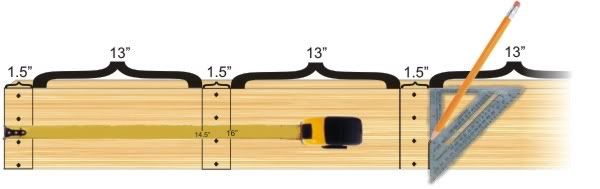 Then with your pencil, mark circles where you want to drill the pilot holes. Space them out a bit, I’d recommend 4-5 screws per shelf side. Start drilling pilot holes. Keep the drill bit plum.
After each hole is drilled, you are ready to start constructing each layer from the bottom up. Corner clamps or friends really come in handy during this phase. So do those 13” support 2X12”s if they are cut perfectly they will hold up each successive shelf for you as you drive the screws in. Drill in each screw until the head sinks into the wood deeply. This will give it the most strength and allow you to putty or caulk over the holes when you are finished building it.
After each piece of 2X12” is in it’s proper position you should have a steady and heavy built-in shelf. Make sure the base is secured and it is snugly compressed by the floor and ceiling. If necessary screw it into the ceiling or floor or wall, make sure this behemoth doesn’t move at all.
At this point, if you want a utilitarian shelf only, without any of the fixin’s, you are done! However, I recommend you go on to the next step if you don’t want it to look unfinished.
Lipstick and Makeup
Caulk or putty the screw holes. Wait until it dries and sand until holes are invisible. Sand all surfaces lightly to get rid of slivers. Clean off with damp cloth, and paint it any color. Depending on how well the paint soaked in you may want to apply a second coat. If you really want to dress it up you can wrap a little trim around the bottom and molding around the ceiling, then it will truly be a built in.
Shelf Liners

This next step I highly recommend because it will prevent wear and tear on your records’ spines from simply sliding the records in and out. Cut pieces of felt to the lengths and widths of each shelf. (Use rubber gloves for this next part) Sparingly spray the back of the felt and the three surfaces of the wood that will touch your records (not the underside of the shelves obviously) with spray glue. Carefully adhere the felt to the shelf surface and quickly remove any wrinkles before the glue dries. It only takes about 30 seconds for the glue to set, so again a friend might come in handy for the longer spans. This is a messy job, you will definitely need paint thinner or mineral spirits to clean up afterward. If you are doing the 7 inch add on, don’t line the top shelf with felt until the next step is complete.
Optional 7 inch compartments
Depending on the span of the distance between S1 and S2 (again you need 16” minimum to proceed) cut your 1X7” pieces to fit using the formulas provided on the printable plans.
 Starting with the vertical supports, (A1 and A2 on the printable plans) use your square and pencil to divide the wood into 4 identically sized quarters. Since the wood is 1” thick you’ll need to cut out an inch wide slot for the intersection of the horizontal run connection it makes. Repeat these same steps with the horizontal shelves. (G on the printable plans) Make sure your measurements are precise on these cuts or it won’t fit properly.
Finally, glue or screw them at their intersection and you have a sturdy little divider that slides right in place. Secure it with wood glue, adhere the remaining felt and it’s complete!
Stack Stoppers?

This will prevent your stacks of records from sliding apart at the bottom. Stick a little Velcro on the bottom of a 12” long quarter round piece of wood and it will stick to the felt bottom perfectly. As your collection grows, you pick it up and move it on down the line.
Done!
Well that is unless you want to build a beer holder for the side, if so you can get the plans for it right here.
UPDATE: 4-6-2011
Money Saving Tip:
For those on a budget, instead of using one long 2X12" piece of wood for the base you could save a few bucks by building the base out of several 2X4" pieces.

Money Saving Tip:
For those on a budget, instead of using one long 2X12" piece of wood for the base you could save a few bucks by building the base out of several 2X4" pieces.

Time Saving Tip:
To save a little bit of time and energy, before cutting any of the wood, paint it or stain it on a saw horse or work bench. It's easier to paint several long pieces of wood on a bench then it is to paint the fully erected shelf. Also, apply the felt before cutting the wood too. It's easier to cut felt in one long strip then multiple sections for each shelf dimension. Then after the wood is painted and felt applied, cut the wood and touch up paint as needed.
Share your progress and pics of the finished shelves:
To save a little bit of time and energy, before cutting any of the wood, paint it or stain it on a saw horse or work bench. It's easier to paint several long pieces of wood on a bench then it is to paint the fully erected shelf. Also, apply the felt before cutting the wood too. It's easier to cut felt in one long strip then multiple sections for each shelf dimension. Then after the wood is painted and felt applied, cut the wood and touch up paint as needed.
Share your progress and pics of the finished shelves:
Mike sent me some pictures of his shelves he built using these plans. Instead of painting them like I did, he bought higher quality wood and stained and added clear coat. As you can see, it looks great.
Thanks, Mike, for sharing these photos!
Thanks, Mike, for sharing these photos!


UPDATE: 2-25-2016
I keep getting great feedback and photos of variations of these record shelving plans. Please keep sending me your pictures of how it turned out, I love seeing them! So thanks for the update Craig! |
| Craig Blackburn Jr's 2 Tier Record Shelf / Console Variation |
Please keep the questions and pictures coming if you have them. Thanks! - rchecka